Wednesday, 14 April 2010

Peas In A Pod

Unlike most adults and even children, babies find themselves most secure and safe when wrapped up tight whereas we feel safer being able to move our limbs if we need to


Like the straitjacket, it must also be to do with safety, to prevent the baby crawling away or putting objects in their mouths. My guess is it has a lot to with the way in which babies are carried, in the cradled arms of someone - in the same way I felt comfortable and at ease in Ron Arad's chair the Restless exhibition at the Barbican

This idea of wrapping up your baby has founded the idea of little pod-like cocoons, shown above. The two green ones were made using Crochet, the process of creating fabric from yearn or thread using a crochet hook. This fabric as you can see is thick but unlike most manufactured fabrics like cotton has some stretch in it, allowing the baby to feel cocooned but also allowing them to move around a bit


I cannot help but think the cocoon that the babies feel safe look a lot like the pod-shape of this bee or wasp thats been wrapped up by a spider, not just the shape but texture, the Crochet looks a lot like that of a spider web...

Restraints

Staying with the idea of trapping I want to see how us humans restrain someone to gain a physical advantage over them


The obvious example is a Straitjacket, typically used in mental asylums to restrain the inmates from causing harm to others and mainly themselves. So this is actually an example of when people have needed to gain an advantage just for safety reasons, defence rather than potential offence. The garment is shaped very much like a normal jacket but with extra long arms. The sleeves are typically sewn shut at the ends - a significant restraint in itself because it restrains the use of the hands. The arms are then folded across the front, with the ends of the sleeves wrapping around to faster or tie behind the back. The straitjacket can cause tremendous pain as blood runs to the elbows, as circulation and movement is limited and can cause swelling. Due to the reputation of being hard to escape from, it has become a favourite of escape artists, with the current record at 18.8 seconds


As you can imagine the idea of restraining someone provokes exploitation and often torture. An example of which being the shocking images leaked from Guantanamo Bay, a detainment facility of the United States located in Cuba. Mainly complaints have been published by former detainees about the traumatic time spent in Guantanamo. Three British prisoners, now known in the media as the Tipton Three were released in 2004 without charge, The three have alleged on going torture, sexual degradation, forced drugging and religious persecuation being committed by U.S forces. Detainee Mehdi Ghezali have claimed that he was the victim of repeated torture, Omar Deghayes alleges he was blinded by pepper spray during his detention, Juma Al Dossary claims he was interrogated hundreds of times, beaten, tortured with broken glass, barbed wire, burning cigarettes and David Hicks also made allegation of torure and mistreatment in Guantanamo Bay but as part of his plea bargain Hicks withdrew the allegations

Looking at these two very extreme examples of restraint I want to take the route of simple restraint, that given by a straitjacket - a means of restraining someone with the potential of offence but not the physical act of harming them

Monday, 12 April 2010

Metamorphosis

Now for a little detour just still staying with the natures amazing mechanisms

After looking at the traps seen in the spider web and the carnivorous plants, where mechanisms are designed to attack the prey when they are not expecting it. I began thinking of mechanisms in nature where something puts itself into a state of disadvantage by restricting their movement and thought of the cocoon that caterpillars makes when they transform into a butterfly

A caterpillar spends most of its life crawling around on the ground and leaves, but when it strong and ready it sets about the process to become an adult. They find a sheltered, safe spot in which to Pupate, or transform into an adult. This happens inside a shall known as a Chrysalis, but the specifics differ between species


This the Monarch caterpillar. After wandering for a while, the caterpillar makes a simple silk pad on the underside of a branch or twig. It uses a hook-covered appendage called a Cremaster to attach itself to this pad. It twists around, embedding it cremaster firmly in the silk.Then, it sheds its skin, revealing the chrysalis. The chrysalis hangs upside down from the cremaster until the butterfly is ready to emerge, or eclose

Other caterpillars adopt different processes when they pupate. Some make a silk hammock from a tree branch and pupate right-side up, others make a sling. The chrysalis starts out soft and skin-like, but gradually hardens to form a protective shell. Alternatively moth caterpillars spin a cocoon to protect their chrysalis, which starts soft but gradually hardens. The moth caterpillar may also disguise the cocoon with leaves or other debris

The transformation within the chrysalis is truly amazing, the caterpillar is affectively recycled. Most of the body is broken down into imaginal cells, which can then become any type of cell. Theses cells are then rearranged into a new shape, parts like the caterpillars legs are left more of less unchanged during this process. This process is known as Holometabolism and depending on the specie it takes around two weeks, however often it remains in the chrysalis during the colder winter mouths

The Dionaea Muscipula

After looking at how the spider uses its web to catch flies, I started thinking about how mechanisms are used in nature when "Gaining an advantage over something else". Then I remembered the Dionaea Muscipula, the Venus Flytrap to most people

The Flytrap is actually only one of 630 species of Carnivorous plants, these are plants that derive some or most of their nutrients from trapping and consuming animals or protozoans, typically insects and other arthropods. These plants are typically found in areas where there are poor levels of nutrients in the soil so these plants have evolved to survive. There are five trapping mechanism that these plants have evolved to perform, they are the Pitfall trap, Flypaper trap, Snap trap, Bladder trap and Lobster-pot trap

The Pitfall trap works in a very simple way, they trap prey in a rolled leaf that contains a pool of digestive enzymes or bacteria. These plants live in area of high rainfall in South America and consequently have a problem ensuring their pitchers do not overflow. To counteract this problem, natural selection has favoured the evolution of an overflow similar to that of a sink - a small gap in the zipped-up leaf margins allows excess water to flow out of the pitcher

The Flypaper trap works by simply getting the insect pray to stick to
the leaves. The leaf of the flypaper trap is studded with mucilage-secreting glands, which are short and nondescript. Once trapped the blade leaf rolls (to prevent rain from splashing the prey off the leaf surface) or dishing of the surface under the prey to form a shallow digestive pit

The Snap trap is characterised by the famous Venus Flytrap. Its trapping mechanism has also been described as a Mouse trap or Man trap based on their shape or rapid movement. Each trap has two lobes that are hinged along the midrib. Trigger hairs on these lobes are sensitive to touch. When a trigger hair is bent, stretch-gated ion channels in the membranes of cells at
the base of the trigger hair open, generating a an action potential that propagates to cells in the midrib. These cells respond by pumping out ions, which may either cause water to follow by osmosis or rapid acid growth. Changes in the shape of cells in the midrib allow the lobes, held under tension, to snap shut, flipping rapidly from convex to concave and interring the prey. This process takes less than a second! Once sealed the lobes act as walls of a stomach in which digestion occurs over a period of one to two weeks. Leaves can be reused three or four times before they becomes unresponsive to stimulation

The Bladder trap works by the plant creating a partial vacuum inside the bladder by it pumping ions out of the interior. The bladder has a small opening, sealed by a hinged door. Aquatic invertebrates such as Daphnia touch hairs on the leaves and deform the door by lever action, releasing the vacuum. The invertebrate is sucked into the bladder, where it is digested

Finally a Lobster-pot trap is a chamber that is easy to enter, and whose exit
is either difficult to find or obstructed by inward-pointing bristles. A Y-shaped modified leaf allows prey to enter but not exit. Inward-pointing hairs force the prey to move in a particular direction. Prey entering the spiral entrance that coils around the upper two arms of the Y are forced to move inexorably towards a stomach in the lower arm of the Y, where they are digested. Prey movement is also thought to be encouraged by water movement through the trap, produced in a similar way to the vacuum in bladder traps, and probably evolutionarily related to it. Above is a sketch of an actual trap made to catch lobster, as you can see the design is heavily inspired by this plant mechanism and is probably the source for the plants name

I really like this idea of a hidden mechanism to trap your prey and how it ties in to my title Weapon

Sunday, 11 April 2010

Links And Connections

Two years ago I was given the title Links And Connections for an AS level product design exam module. For this project I also rooted a lot of my research and inspiration in the structure that makes up a spider web. The basis that this design was created was the idea of a spider web spread across a metal frame that sags in the middle. I designed it around a photograph I took of a web that was spun around the rim of a metal pole. Seven chains run from the metal frame to a central suspending ring, in the same way the first strong silk threads are constructed by the spider. And by using rope I could thread it round the chains loops like the second part of the spiders construction creating support as a seat and backrest

By relaxing my eyes, I then started looking at the standard spider web spiral in other ways. The crisscross effect does not have to be limited to spokes and spirals, they can extend all over the place creating interesting gaps like those seen here in the Vegetal Chair by Ronan and Erwan Bouroullec. This new Vitra chair is made of dyed polyamide and took the designers three years to perfect

8 Legged Freak

Last night I was browsing through BBC iPlayer when I stumbled across the third episode of Richard Hammond's The Invisible World - Off The Scale. This series consisted of three episodes, exploring the world that we as humans cannot see but shapes our lives. The human eye takes about 50 milliseconds to blink, but it takes the brain around 100 milliseconds longer to process what can be seen. We might not be conscious of this time lag going on but, in those milliseconds, there are a huge number of happenings that pass us by. With state of the art cameras you can see for example, the shock wave emitted by a bomb simply by slowing footage down or learn that the fasted thing in the world lives in cow pat. For me the most fascinating feature of this series was the part about spiders and their webs

Through the use of amazing macro photography we understand how a spider sets about constructing its web. First the the spider uses one several different types of silk, this one being particularly strong and sets out the primary stands including the 'spokes' of the web. Next the spider turns back on himself using a different type of silk this time very sticky, to spin the spirals and setting the lethal trap for the insect to touch, making sure to leave the centre of the wet sticky silk free where he sits and waits for his prey. I really like this idea of a trap and can see a huge range of ideas that use in it as a weapon! Through very detailed photography we can see how this silk is produced

On the abdomen of the spider are four organs called Spinnerets. Each of these spinnerets are dotted with mobile finger like spigots. These squirt
out liquid protein, which dries when coming into contact with air forming a super strong thread. With all these thread twisted together you end up with an even stronger one. A spider can produce over 700 metres of silk in one continuous strand. This strand is 30 times thinner than human hair and if it was as thick as a pencil it could pull an ocean liner with ease. This is an image taken from the episode, showing the four spinnerets and there finger like spigots squirting out liquid protein

Scientists also believe that the strength of a spiders web is down to the water droplets found at every junction. Inside each droplet are strands of web that are tightly curled, so when a fly hits the web the strands unravel and make the web flex and stretch

This technology has been applied to man made objects such as a bullet proof vest. The harm inflicted from a bullet travelling at 600mph is dramatically lowered by the presents of a vest. The vest is made from many layers of densely woven or laminated fibres that spread the energy of the impact. There has been a lot of work done on the idea of carbon fibres, a strand 5 times thinner than a human hair is 10 times stronger than steel! Each fibre is made of more than 1 million tubes of carbon just 1 atom thick

I am now really interested in the idea of incorporating a trapping component into my weapon design. If you want to view this episode click on the link below, I strongly recommend you do!
Wednesday, 7 April 2010

Ron Arad

I have for a while been a huge fan of Ron Arad, an Israeli industrial designer, artist and architect. And so when I heard he was exhibiting at the Barbican in London I was quick to go and visit to get some inspiration for my project

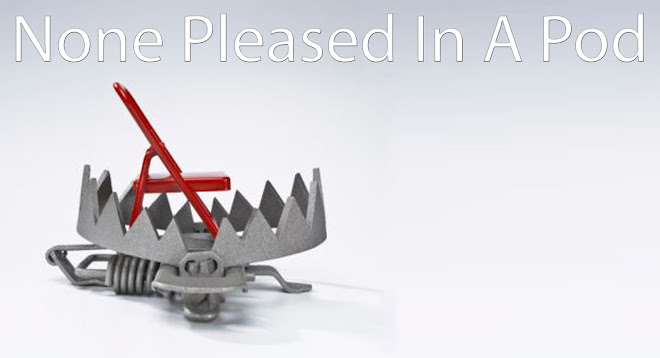
At the exhibition I had the opportunity to experience sitting in one of his chairs to see how they differed from ones in my everyday life. I found I was intrigued to sit in them like a fly is to a Venus Flytrap, not by the scent but to explore how I will interact with the form of his chair. I was drawn to one chair in particular, shown below based on the concept of how a mother holds a baby in her arms, and I would like to use this as a possible means to lull someone to sit in the chair, giving me the advantage over the restrained victim

As you can see from from the image you lie on your back, on a cleverly formed piece, then you can rock forwards and back, up and down in all directions with little effort